

Born on Independence Day in 1920 in Chicago, Schab was the eldest of three brothers.
He joined the Navy at 18, following in the footsteps of his father, he said in a February interview for Pacific Historic Parks.
On what began as a peaceful Sunday, December 7, 1941, Schab, who played the tuba in the USS Dobbin’s band, was expecting a visit from his brother, a fellow service member assigned to a nearby naval radio station. Schab had just showered and donned a clean uniform when he heard a call for fire rescue.
He went topside and saw another ship, the USS Utah, capsizing. Japanese planes roared through the air.
“We were pretty startled. Startled and scared to death,” Schab recalled in 2023. “We didn’t know what to expect, and we knew that if anything happened to us, that would be it.”
He scurried back below deck to grab boxes of ammunition and joined a daisy chain of sailors feeding shells to an antiaircraft gun above.
His ship lost three sailors, according to Navy records. One was killed in action, and two died later of fragment wounds from a bomb that struck the stern. All had been manning an antiaircraft gun.
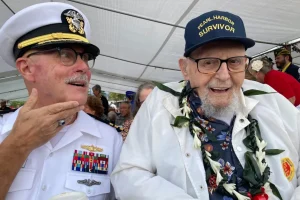
Schab spent most of the war with the Navy in the Pacific, going to the New Hebrides, now known as Vanuatu, and then the Mariana Islands and Okinawa, Japan.
After the war he studied aerospace engineering and worked on the Apollo spaceflight program as an electrical engineer for General Dynamics, helping send astronauts to the moon.
Schab’s son also joined the Navy and is a retired commander.
Speaking at a 2022 ceremony, Schab asked people to honor those who served at Pearl Harbor.
“Remember what they’re here for. Remember and honor those that are left. They did a hell of a job,” he said. “Those who are still here, dead or alive.”
