
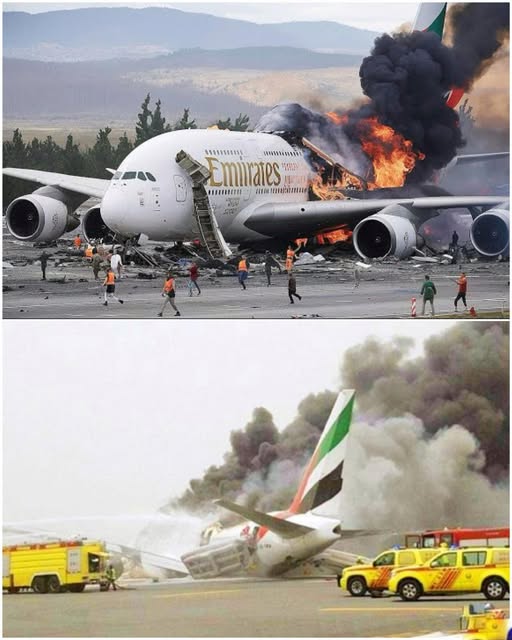
Passengers later described moments of intense fear as the aircraft descended. One traveler, Iype Vallikadan, told reporters that the pilot had warned the cabin of a potential landing gear problem shortly before touchdown and informed them that an emergency landing would be necessary. According to accounts carried by international news agencies, the calm but urgent tone of the announcement prepared passengers for what was about to unfold.
Initial statements from Emirates suggested there may have been wind shear conditions at the time of landing. Wind shear, a sudden change in wind speed or direction, is a known aviation hazard that can complicate approaches, particularly during hot weather conditions common in the region. While the airline acknowledged the presence of such conditions, officials emphasized that it was too early to determine whether wind shear played a direct role in the crash-landing.
The passenger manifest reflected the global nature of modern air travel. Among those on board were six United States citizens, along with 226 passengers from India, 24 from the United Kingdom, 11 from the United Arab Emirates, six from Saudi Arabia, five from Turkey, and four from Ireland. Additional passengers hailed from Australia, Brazil, Germany, Malaysia, Thailand, Croatia, Egypt, Bosnia and Herzegovina, Lebanon, the Philippines, South Africa, Switzerland, and Tunisia. The diversity of nationalities highlighted the international stakes of aviation safety and crisis response.
In the hours following the incident, Boeing, the U.S.-based manufacturer of the aircraft, announced that a technical team was prepared to assist with the investigation in coordination with the National Transportation Safety Board. The collaboration aims to determine the precise sequence of events that led to the emergency landing, including mechanical performance, environmental factors, and pilot response.
Dubai’s aviation authorities moved quickly to initiate a formal investigation. Saif Mohamed Al Suwaidi, Director General of the General Civil Aviation Authority, confirmed that an investigation team had been activated and was working alongside Emirates and airport officials. In a public statement, he emphasized that the immediate priority was the safety and well-being of passengers and crew, with a full technical review to follow.
The crash-landing caused widespread disruption at Dubai International Airport. Dozens of incoming and outgoing flights were delayed or diverted, with some passengers experiencing delays of up to six hours. Airport operations gradually resumed later in the evening, shortly before 7 p.m. local time, after emergency crews secured the runway and ensured the area was safe for traffic.
Founded in 1985, Emirates Airlines has built a reputation as one of the world’s leading carriers, known for its extensive international network, modern fleet, and strong aviation safety record. The airline’s ability to evacuate nearly 300 people from a burning aircraft without passenger fatalities is being cited by aviation analysts as evidence of rigorous training standards and effective crisis management procedures.
Dubai International Airport, which handled approximately 78 million passengers last year, is no stranger to high-pressure operations. Still, incidents of this magnitude are rare, and the successful evacuation is likely to be studied globally as a case study in emergency response, aircraft evacuation procedures, and airport firefighting effectiveness.
While the investigation continues, the focus remains on honoring the firefighter who lost his life in the line of duty and supporting those affected by the incident. The crash-landing serves as a stark reminder that even in an era of advanced aviation technology, safety ultimately depends on preparation, professionalism, and the courage of those who respond when something goes wrong.
For passengers who walked away from the runway that day, the experience will be unforgettable. For the aviation industry, it will be closely examined. And for the families of emergency responders, it stands as a powerful testament to the risks taken every day to ensure that others make it home safely.
